Free guide for Texans in a divorce
Coming through a Texas divorce whole: your finances, your children, and yourself.
A plain-English strategy guide for people who are already in the process. What winning actually means, which battles are worth fighting, when to settle, what to tell your children, and how to land well in the first year after.

Not sure yet whether to file? Start with the companion guide, Thinking About Divorce in Texas, which covers how the process and the law actually work. This guide picks up from there.
Read the first guide →The idea behind the guide
You are keeping three ledgers at once.
There is a version of divorce where you win the argument and lose almost everything that mattered. It is usually the product of dozens of small decisions made under stress, and most of them come from improving one ledger while quietly draining another.
Financial
What you actually walk away with: liquid assets, retirement after tax, debt, income, and whether your monthly budget works.
Relational
Your relationship with your children and your working relationship with their other parent, for the rest of your life.
Personal
Your health, your work, your capacity to parent, and your ability to build what comes next.
The client who does best is almost never the client who fights hardest. The client who does best is the one who knows what they are actually trying to achieve and spends their money, energy, and credibility only on that.
Inside the guide
Thirteen chapters and two worksheets. No sales pitch, no promised outcomes.
Define your objectives before the case defines them
Three non-negotiables, what you are willing to trade, and what you are afraid of. Written down in month one, before you are tired.
Choosing your battles
The four categories every issue falls into, the arithmetic test, the five-year test, and the trap people walk into most.
When to settle and when to fight
Fight when safety or disclosure is at issue. Do not fight to be proven right. Plus a mediation-day checklist.
What actually predicts how your children do
The three factors researchers have consistently identified, and why the one you most control matters most.
Communication discipline
Brief, informative, friendly, firm. Write it, then wait. The message you want to send and the one you should.
Protecting your financial future
Why not all assets are equal, how to be honest with yourself about the house, and the paperwork that quietly falls apart after the decree.
All thirteen chapters
- What Winning Actually Means
- Define Your Objectives Before the Case Defines Them
- The Leverage You Actually Control
- Your Emotional State Is a Strategic Asset
- Choosing Your Battles
- When to Settle and When to Fight
- What Actually Predicts How Your Children Do
- What to Tell Your Children
- Building a Co-Parenting Relationship That Outlasts the Case
- Communication Discipline
- Protecting Your Financial Future
- The Support Team You Actually Need
- The First Year After
Your toolkit: an Objectives Worksheet to complete in the first month and bring to mediation, a Post-Divorce Budget and House Check, and seven checklists you can return to when a decision is in front of you.
A few things that surprise people
Family cases resolve without a final trial. The question is rarely whether you will settle, but when and on what terms.
A common pattern: the fight costs twice what it wins. People routinely spend eight thousand dollars fighting over four thousand dollars of property.
Not two months. Most people and most children stabilize substantially within about two years of the decree.
Questions the guide answers
Getting through it, in plain English
Short answers to the questions clients ask once the case is under way. The guide covers each one in more depth.
What does a good outcome in a divorce actually look like?
Fairness and what your spouse deserves are feelings, not objectives. A useful way to think about the outcome is that you are keeping three ledgers at once: the financial ledger (your actual position after tax and in cash, not the headline number in the decree), the relational ledger (your relationship with your children and your working relationship with their other parent), and the personal ledger (your health, your work, and your capacity to parent). Most bad decisions in divorce come from improving one ledger while quietly draining another.
Should I settle my Texas divorce or fight?
Roughly nine in ten family cases resolve without a final trial, so the question is rarely whether you will settle but when and on what terms. Settling early is usually cheaper, faster, and less damaging, but do not settle before you know what is in the estate, especially if you were not the spouse managing the money. Litigation is warranted when your children’s safety is at issue, when the other side’s proposal is far outside the range of reasonable outcomes, when your spouse is hiding assets or refusing to produce information, or when a contested legal issue justifies the cost. Do not fight to be proven right, because settling feels like losing, or because the other lawyer sent an obnoxious letter.
Which issues in a divorce are worth fighting over?
Every issue falls into one of four categories: worth fighting for and winnable (fight); worth fighting for but unlikely to be won (get candid counsel); not worth fighting for but winnable (the trap, because winning an unimportant point can be a net loss); and not worth fighting for and not winnable (concede early and get credit for it). Two practical tests help: the arithmetic test, which asks what it will cost in fees against what it is worth, and the five-year test, which asks whether this will have mattered in five years. Furniture and the contents of the garage almost never pass either test. Retirement accounts, geographic restrictions, and the possession schedule almost always do.
Will my children be okay after the divorce?
Most children of divorce do fine. Divorce is a real risk factor, but the majority of children adjust over time and function within the normal range. Research has consistently identified three factors that matter most: the level of conflict between parents, the quality of parenting after separation, and economic stability. Children removed from high-conflict households tend to do better after a divorce, while children removed from low-conflict households tend to do worse in the short term, which suggests children are responding to the conflict rather than to the legal event. Your conflict level with your co-parent is the variable you most control and the one that matters most.
What should I tell my children about the divorce?
Every child needs three core messages: this is not your fault, both of your parents love you, and both of your parents will keep taking care of you. Tell them together if you possibly can, keep it age-appropriate and concrete, and do not explain why the marriage ended. The reasons belong to the adults, and a child who is told about an affair, money, or who wanted this receives a burden they cannot carry. Never disparage the other parent within earshot, never use children as messengers, never ask them about the other parent’s household, and never tell them about the litigation.
Should I keep the house in my divorce?
The house is the most emotionally loaded asset and the one people most often keep when they should not. Build a real post-divorce budget before you agree to anything, including the costs that are about to appear: separate housing, health insurance you may have been getting through a spouse, childcare, and the expense of two households on the income that supported one. Run the mortgage, taxes, insurance, and maintenance against your actual post-divorce income. If it does not work, selling is not a failure. It is the decision that protects everything else. Remember also that a hundred thousand dollars in home equity, in a retirement account, and in a brokerage account are three different amounts of money once you account for taxes and liquidity.
How should I communicate with my co-parent during the case?
Most damage between co-parents happens in writing, and writing is the one place you have complete control. Keep every message brief, informative, friendly, and firm. Before you send anything, ask whether you would be comfortable with a judge reading it aloud. Draft the response you want to send, wait an hour or overnight, then send the response you should send. Answer only what was asked, keep it to logistics, use one channel, and stay off social media about your divorce entirely. Never send anything about your case to anyone but your lawyer, and assume your spouse can see shared accounts and devices.
Can starting therapy during a custody case be used against me?
The concern is not imaginary. In Texas, the mental health privilege has an exception where a party relies on a mental or emotional condition as part of a claim or defense, and courts weigh the need for the information against the privacy interests the privilege protects. Raise it with your lawyer so she can advise you on your specific situation, but do not use it as a reason to go without support. A parent who gets treatment and functions well is in a far stronger position than a parent who white-knuckles it and comes apart in month eight. Judges are not troubled by a parent who sought help. They are troubled by a parent who is not coping.
Current as of November 2026. These are general descriptions and general observations, not advice about your situation. Nothing here is medical, psychological, or financial advice. Outcomes depend on the facts of each case, the county, and the court.
If you need help now: the 988 Suicide and Crisis Lifeline is available by call or text at 988. If there is violence in your home, the National Domestic Violence Hotline is 1-800-799-7233, and you should tell your lawyer, because it changes both the strategy and the available legal protections.

About the author
Becca M. Kennedy
Becca has practiced family law exclusively for more than twenty years and is board certified in family law by the Texas Board of Legal Specialization. She has tried contested cases and is not squeamish about litigation when it is warranted. She has also been through her own divorce.
She keeps a deliberately small docket and handles every contested case personally, start to finish. If a case is not a fit for her practice, she says so directly and points people to someone who is.
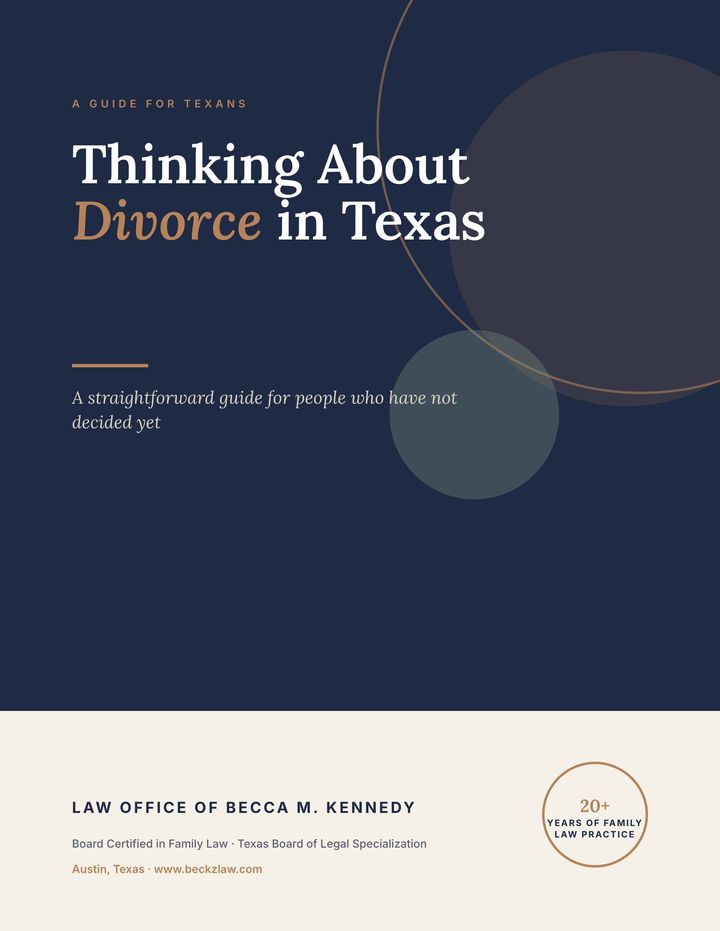
The companion guide
Thinking About Divorce in Texas
Fourteen chapters on how Texas divorce actually works, how long it takes, what the first ninety days decide, and what it costs. Written for people who have not decided yet.
Get the first guide →Read it straight through once. Then keep it close.
Each chapter ends with a short checklist you can come back to when a decision is in front of you.
Get the free guide